Hardware: Kaggle, 2× Tesla T4 (GPU) · Driver: python run_experiment.py --device cuda
Date: 2026-07-14 · Training wall-clock: ~9.8 h (baseline 68.9 min + scaled 444.7 min + assisted 75.2 min)
Provenance. The Kaggle notebook's automatic
git pushfailed with a 403 (itsGITHUB_TOKENsecret lacked write scope), so every number in this file is transcribed directly from that run's captured stdout — the per-iteration self-play termination tables, the periodic evaluation lines, and the loss curve. Two things could not be recovered from the surviving logs and are marked where they appear: (1) the win/draw/loss split of each stage's final stand-alone 50-game evaluation (only its Elo survived), and (2) a downloadable trained checkpoint, which was lost with the Kaggle session (re-run the driver to regenerate one). The figures below are plotted directly from the per-iteration numbers transcribed in this file.
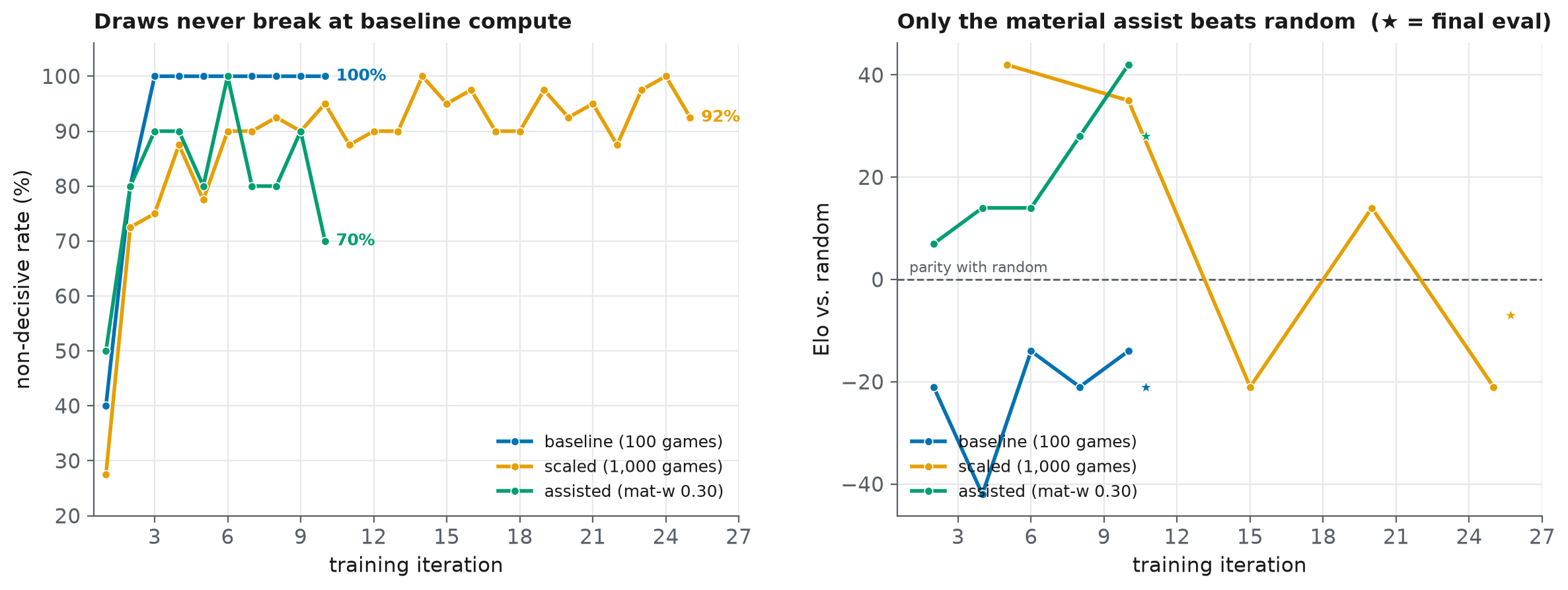
Run configuration#
All three stages share the identical code and network (4 residual blocks, 64 channels); they differ only in the variable under test.
| Stage | Iterations | Games/iter | Total games | Sims/move | Self-play material w |
|---|---|---|---|---|---|
| baseline | 10 | 10 | 100 | 100 | 0.00 |
| scaled | 25 | 40 | 1,000 | 160 | 0.00 |
| assisted | 10 | 10 | 100 | 100 | 0.30 |
Evaluation at each checkpoint is 50 games vs. RandomAgent at 50 sims/move.
Headline results#
The driver's two headline metrics are the self-play non-decisive rate (fraction of games not ending in checkmate) and Elo vs. random. "Non-decisive rate" below is the final iteration's rate (the end-of-training state); the aggregate over all of a stage's games is given alongside because for the baseline the two differ sharply (see §A).
Experiment A — compute scaling (material w = 0 in both)#
| Run | Total games | Sims/move | Non-decisive (final iter / all games) | Elo vs random |
|---|---|---|---|---|
| baseline | 100 | 100 | 100% / 92% | −21 |
| scaled | 1,000 | 160 | 92% / 88% | −7 |
Result. 10× the self-play raises Elo (−21 → −7) and produces more checkmates in aggregate (8/100 = 8% → 120/1000 = 12%), but the cycle is not broken: the network still cannot reliably convert, and Elo stays negative.
Experiment B — self-play signal at fixed compute (same budget as baseline)#
| Run | Total games | Sims/move | Material w | Non-decisive (final iter / all games) | Elo vs random |
|---|---|---|---|---|---|
| baseline | 100 | 100 | 0.00 | 100% / 92% | −21 |
| assisted | 100 | 100 | 0.30 | 70% / 81% | +28 |
Result. Blending a 0.30 material term into self-play leaf evaluation — at the same compute as the baseline — drops the final-iteration non-decisive rate to 70%, raises the aggregate checkmate count to 19/100, and flips Elo from −21 to +28. The engine now beats random. This is the more cost-effective lever.
Reading the two together#
Both levers move the metrics, so the plateau is driven by both limited compute and an impoverished self-play signal (the "yes | yes" row of the §5.3 reading matrix) — but the signal lever does more per unit of compute.
A. Per-iteration self-play termination#
Counts are games ending by each reason. CM checkmate · ST stalemate ·
INSUF insufficient material · REP threefold repetition · 50M fifty-move ·
CAP hit the max_moves = 200 cap. "Non-dec %" = fraction not won by checkmate.
Baseline — 10 iters × 10 games, 100 sims, mat-w 0.00#
| Iter | CM | ST | INSUF | REP | 50M | CAP | Non-dec % |
|---|---|---|---|---|---|---|---|
| 1 | 6 | 0 | 0 | 0 | 0 | 4 | 40% |
| 2 | 2 | 0 | 0 | 8 | 0 | 0 | 80% |
| 3 | 0 | 0 | 0 | 10 | 0 | 0 | 100% |
| 4 | 0 | 0 | 0 | 10 | 0 | 0 | 100% |
| 5 | 0 | 0 | 0 | 10 | 0 | 0 | 100% |
| 6 | 0 | 0 | 0 | 10 | 0 | 0 | 100% |
| 7 | 0 | 0 | 0 | 10 | 0 | 0 | 100% |
| 8 | 0 | 0 | 0 | 10 | 0 | 0 | 100% |
| 9 | 0 | 0 | 0 | 10 | 0 | 0 | 100% |
| 10 | 0 | 0 | 0 | 10 | 0 | 0 | 100% |
| ALL | 8 | 0 | 0 | 88 | 0 | 4 | 92% |
The draw cycle forming in real time: the early, near-random network scores a few accidental checkmates (8 in iters 1–2), then collapses into pure threefold repetition from iter 3 onward — zero checkmates for the last 80 games. Draws are driven by repetition, not the fifty-move rule.
Scaled — 25 iters × 40 games, 160 sims, mat-w 0.00#
| Iter | CM | ST | INSUF | REP | 50M | CAP | Non-dec % |
|---|---|---|---|---|---|---|---|
| 1 | 29 | 0 | 0 | 0 | 0 | 11 | 27.5% |
| 2 | 11 | 0 | 0 | 29 | 0 | 0 | 72.5% |
| 3 | 10 | 0 | 0 | 30 | 0 | 0 | 75.0% |
| 4 | 5 | 0 | 0 | 34 | 0 | 1 | 87.5% |
| 5 | 9 | 0 | 0 | 31 | 0 | 0 | 77.5% |
| 6 | 4 | 0 | 0 | 36 | 0 | 0 | 90.0% |
| 7 | 4 | 0 | 0 | 36 | 0 | 0 | 90.0% |
| 8 | 3 | 0 | 0 | 37 | 0 | 0 | 92.5% |
| 9 | 4 | 0 | 0 | 35 | 0 | 1 | 90.0% |
| 10 | 2 | 0 | 0 | 38 | 0 | 0 | 95.0% |
| 11 | 5 | 0 | 0 | 35 | 0 | 0 | 87.5% |
| 12 | 4 | 0 | 0 | 36 | 0 | 0 | 90.0% |
| 13 | 4 | 0 | 0 | 36 | 0 | 0 | 90.0% |
| 14 | 0 | 0 | 0 | 39 | 0 | 1 | 100.0% |
| 15 | 2 | 0 | 0 | 38 | 0 | 0 | 95.0% |
| 16 | 1 | 0 | 0 | 39 | 0 | 0 | 97.5% |
| 17 | 4 | 0 | 0 | 36 | 0 | 0 | 90.0% |
| 18 | 4 | 0 | 0 | 36 | 0 | 0 | 90.0% |
| 19 | 1 | 0 | 0 | 39 | 0 | 0 | 97.5% |
| 20 | 3 | 0 | 0 | 37 | 0 | 0 | 92.5% |
| 21 | 2 | 0 | 0 | 38 | 0 | 0 | 95.0% |
| 22 | 5 | 0 | 0 | 35 | 0 | 0 | 87.5% |
| 23 | 1 | 0 | 0 | 39 | 0 | 0 | 97.5% |
| 24 | 0 | 0 | 0 | 40 | 0 | 0 | 100.0% |
| 25 | 3 | 0 | 0 | 37 | 0 | 0 | 92.5% |
| ALL | 120 | 0 | 0 | 866 | 0 | 14 | 88% |
Same pattern at scale: iter 1's untrained net delivers 29 accidental mates, then the rate settles into the high-80s/90s% non-decisive band for the rest of training. More compute keeps a residual trickle of checkmates alive (120/1000 aggregate vs. the baseline's 8/100) but does not escape the plateau.
Assisted — 10 iters × 10 games, 100 sims, mat-w 0.30#
| Iter | CM | ST | INSUF | REP | 50M | CAP | Non-dec % |
|---|---|---|---|---|---|---|---|
| 1 | 5 | 0 | 2 | 1 | 0 | 2 | 50% |
| 2 | 2 | 0 | 0 | 7 | 0 | 1 | 80% |
| 3 | 1 | 0 | 0 | 9 | 0 | 0 | 90% |
| 4 | 1 | 0 | 0 | 9 | 0 | 0 | 90% |
| 5 | 2 | 0 | 0 | 8 | 0 | 0 | 80% |
| 6 | 0 | 0 | 0 | 10 | 0 | 0 | 100% |
| 7 | 2 | 0 | 0 | 7 | 0 | 1 | 80% |
| 8 | 2 | 0 | 0 | 7 | 0 | 1 | 80% |
| 9 | 1 | 0 | 0 | 9 | 0 | 0 | 90% |
| 10 | 3 | 0 | 0 | 7 | 0 | 0 | 70% |
| ALL | 19 | 0 | 2 | 74 | 0 | 5 | 81% |
With the material assist, checkmates keep appearing throughout training instead of dying out — 19/100 aggregate, and the final iteration hits 30% checkmate (70% non-decisive), the best of any stage. Decisive games give the value head a real signal to learn from.
B. Elo vs. random — periodic evaluation checkpoints#
Each row is an independent 50-game match vs. RandomAgent (50 sims/move), logged
during training at the stage's eval_every interval. W/D/L are the raw counts.
Baseline (every 2 iters)#
| Iter | W | D | L | Score | Elo |
|---|---|---|---|---|---|
| 2 | 2 | 43 | 5 | 47.0% | −21 |
| 4 | 0 | 44 | 6 | 44.0% | −42 |
| 6 | 3 | 42 | 5 | 48.0% | −14 |
| 8 | 1 | 45 | 4 | 47.0% | −21 |
| 10 | 2 | 44 | 4 | 48.0% | −14 |
Scaled (every 5 iters)#
| Iter | W | D | L | Score | Elo |
|---|---|---|---|---|---|
| 5 | 8 | 40 | 2 | 56.0% | +42 |
| 10 | 8 | 39 | 3 | 55.0% | +35 |
| 15 | 0 | 47 | 3 | 47.0% | −21 |
| 20 | 6 | 40 | 4 | 52.0% | +14 |
| 25 | 3 | 41 | 6 | 47.0% | −21 |
Assisted (every 2 iters)#
| Iter | W | D | L | Score | Elo |
|---|---|---|---|---|---|
| 2 | 6 | 39 | 5 | 51.0% | +7 |
| 4 | 6 | 40 | 4 | 52.0% | +14 |
| 6 | 5 | 42 | 3 | 52.0% | +14 |
| 8 | 7 | 40 | 3 | 54.0% | +28 |
| 10 | 10 | 36 | 4 | 56.0% | +42 |
Final stand-alone evaluation (a separate 50-game match after training; only the Elo survives in the logs — the W/D/L split was not captured): baseline −21, scaled −7, assisted +28. These are the headline Elo figures above. Note they differ from each stage's last periodic checkpoint (e.g. scaled's iter-25 checkpoint read −21 but its final match read −7) — independent 50-game samples of a near-even engine are noisy, which is itself worth reporting.
C. Training loss#
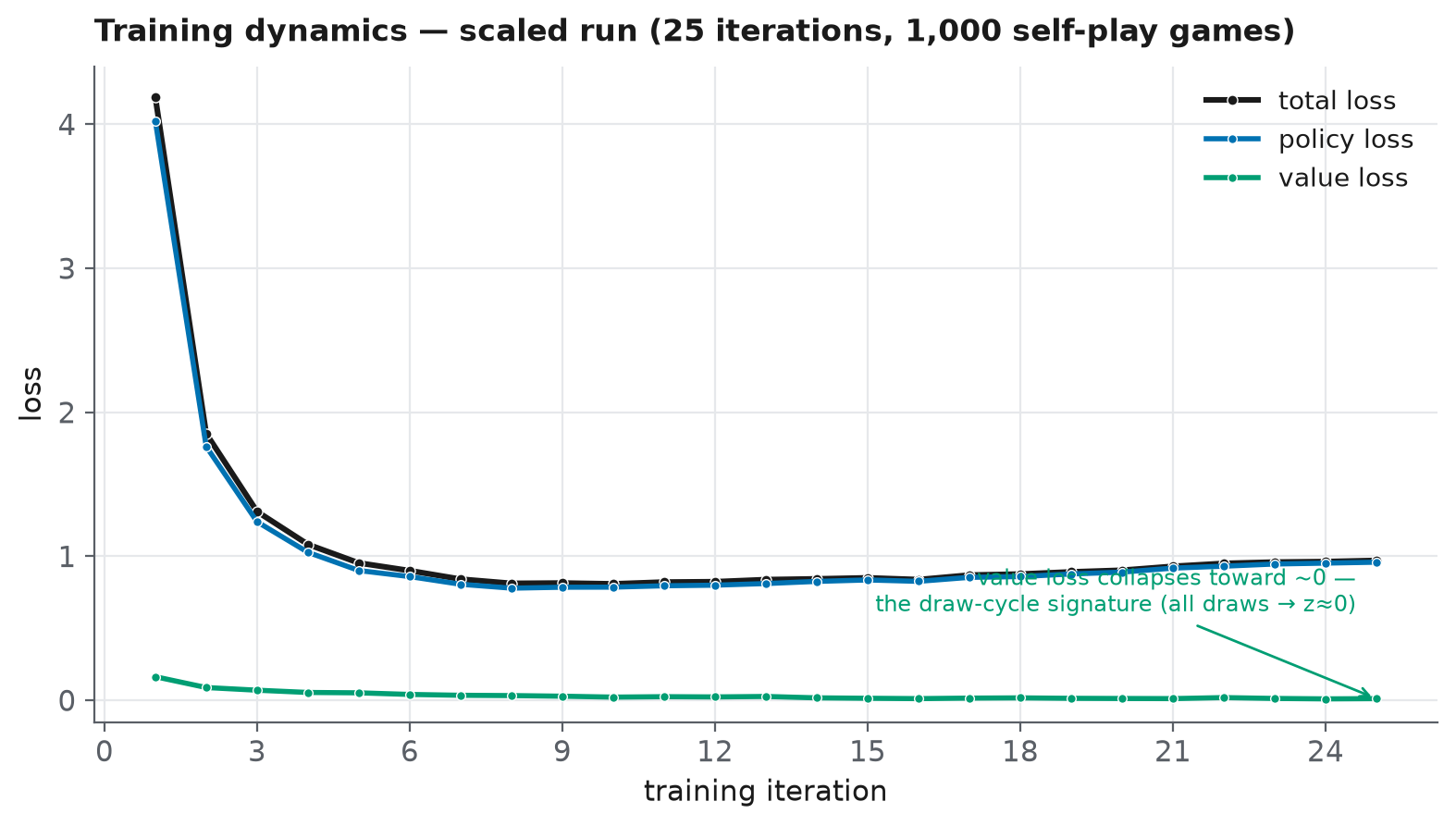
Total loss = policy cross-entropy + value MSE. Start (iter 1) → end (final iter):
| Stage | Policy loss (start → end) | Value loss (start → end) | Total (start → end) |
|---|---|---|---|
| baseline | 4.54 → 0.81 | 0.092 → 0.006 | 4.63 → 0.81 |
| scaled | 4.02 → 0.96 | 0.164 → 0.012 | 4.19 → 0.97 |
| assisted | 4.37 → 0.69 | 0.101 → 0.023 | 4.47 → 0.71 |
Policy loss falls sharply in every stage — the network readily learns to imitate
its own MCTS visit distribution. The value loss is tiny from the start and shrinks
toward ≈0.01: with almost every game drawn, the outcome target z ≈ 0 nearly
everywhere, so the value head has almost nothing to fit. That collapse is the
draw-cycle signature (technical report §6), not a training success.
Key findings#
- The draw cycle is real and self-reinforcing. At baseline compute the near-random network scores a few accidental mates in iters 1–2, then collapses to 100% repetition draws from iter 3 on — the value target flattens to ≈0 and the cycle locks in.
- Compute helps, but does not break it. 10× the self-play (100 → 1,000 games) lifts Elo (−21 → −7) and keeps a residual checkmate rate alive (8% → 12% aggregate), yet Elo stays negative and the non-decisive rate stays in the high 80s/90s%.
- Signal quality is the more efficient lever.
material_weight = 0.30in self-play — at the same baseline compute — drops the final-iteration non-decisive rate to 70%, keeps checkmates appearing throughout training (19/100 aggregate), and flips Elo to +28. The engine beats random. - Both levers help ("yes | yes" in the §5.3 reading matrix): compute helps
and signal helps, each measured on its own. Whether they compound (stacking
them beats either alone) is untested until a combined scaled-plus-assisted run;
it is ready to run on Kaggle as
notebooks/experiment_c.ipynb(python run_experiment.py --device cuda --only-combined). material_weight = 0.30is the recommended self-play default, now set viaMCTSConfig.material_weightand exposed asrun_experiment.py --assist-weight.
Reproducibility#
# All three stages on a GPU (this run):
python run_experiment.py --device cuda

# Fast pipeline check on CPU (~1–2 min, results not meaningful):
python run_experiment.py --quick
Config used (from config.py; stages differ only in iterations/games/sims and the
self-play material weight noted above):
- Network:
num_residual_blocks = 4,num_channels = 64 - Search:
c_puct = 1.5,dirichlet_alpha = 0.3,dirichlet_epsilon = 0.25 - Self-play:
temperature_moves = 15,max_moves = 200 - Training:
epochs_per_iteration = 4,batch_size = 64,learning_rate = 1e-3,weight_decay = 1e-4,replay_buffer_size = 20 000